Buying a used BMW can be an appealing way to enjoy premium interiors, responsive handling, and a more engaging driving experience without paying the price of a brand-new car. However, the purchase price is only one part of the ownership equation.
Maintenance, insurance, fuel economy, and unexpected repairs can make a seemingly affordable BMW expensive to run. The difference often comes down to the car’s condition, service history, and exact engine specification.
Before buying a used BMW in the UK, it’s worth understanding which checks matter, what common problems to investigate, and how to estimate the real cost of ownership.
1. Research the Exact BMW Model, Engine and Year
BMW offers everything from compact 1 Series hatchbacks and popular 3 Series saloons to family-friendly X models and performance-focused M cars. Their running costs and mechanical requirements can vary considerably.
Start by identifying the exact model, generation, engine, gearbox, and registration year. Two cars carrying the same model badge may have different engines and known mechanical issues.
For example, some older BMW diesel engines have documented timing-chain concerns, while certain petrol engines have their own maintenance considerations. Diesel models may also require attention to diesel particulate filters (DPFs) and exhaust gas recirculation (EGR) systems, particularly if they’ve mainly been used for short journeys.
Research the specific engine rather than assuming every BMW shares the same reliability profile.
Consider how you intend to drive, too. A smaller petrol model might suit someone making short urban trips, while a diesel could be more appropriate for regular longer journeys. Your driving pattern, mileage, and local emissions restrictions should influence your decision.
2. Check the Service History and Maintenance Records
A comprehensive service history is one of the most valuable things to look for when buying a used BMW.
Ask for service invoices, digital service records, and evidence of previous repairs. These documents help establish whether the car has received regular maintenance and whether expensive work has already been completed.
Pay particular attention to oil changes, cooling-system maintenance, gearbox servicing where applicable, and repairs relevant to the specific engine.
A full service history is encouraging, but it doesn’t guarantee that a car is mechanically sound. Equally, a vehicle with incomplete records isn’t automatically a bad purchase, although the uncertainty should influence your decision.
Look for consistency between recorded mileage, service dates, invoices, and the car’s overall condition.
If the seller claims that major repairs have been completed, ask for supporting paperwork. A well-documented repair can be reassuring, while an unsupported claim deserves further investigation.
3. Inspect the Tyres, Brakes and General Condition
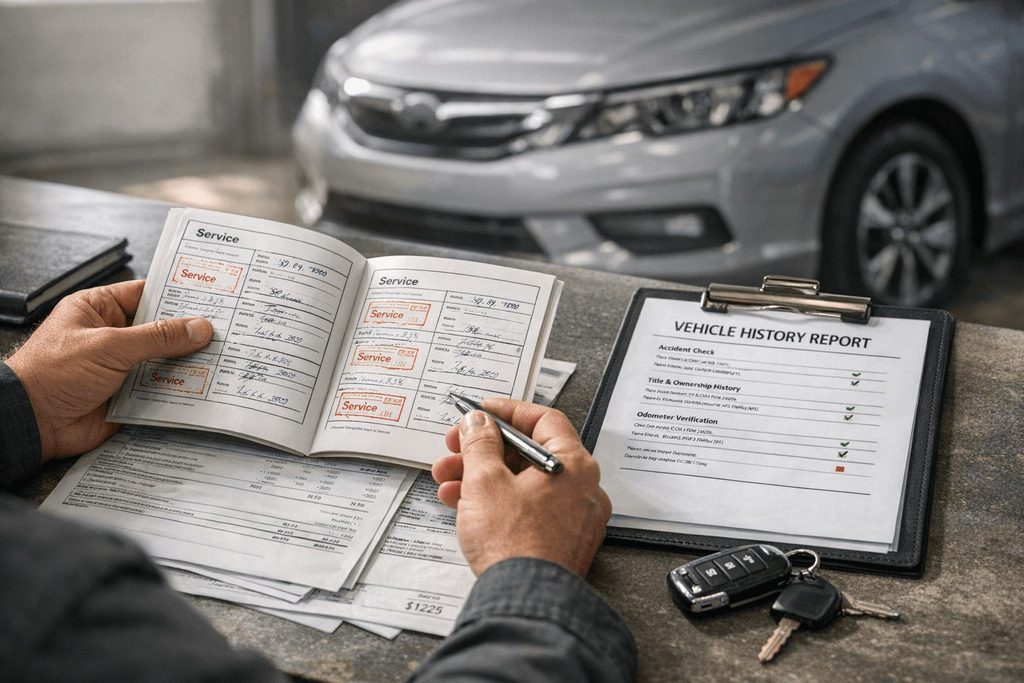
Before buying, inspect the BMW carefully in daylight and arrange an independent inspection if possible.
Start with the tyres. Check tread depth, uneven wear, cracks, and damage. Uneven wear can indicate alignment problems, suspension wear, or previous repairs.
Next, examine the brakes. Listen for grinding or unusual squealing during a test drive and watch for vibration when slowing down. Ask about the condition of the brake pads and discs.
Inspect the bodywork for mismatched paint, uneven panel gaps, rust, and signs of accident repairs. Inside the cabin, test the air conditioning, windows, infotainment system, parking sensors, and other electrical features.
During the test drive, pay attention to steering, suspension noises, engine performance, and gearbox behaviour.
A BMW that looks immaculate in photographs may still need significant mechanical work. If you aren’t confident assessing its condition, arrange a pre-purchase inspection with a BMW specialist.
4. Never Ignore Warning Lights or Unusual Noises
Dashboard warning lights deserve attention, particularly when buying a premium used car.
An illuminated engine warning light may indicate anything from an emissions-system issue to a more serious mechanical fault. ABS, airbag, battery, and cooling-system warnings also require investigation.
Ask the seller to demonstrate that the dashboard warning lights illuminate during startup and then behave as expected. A diagnostic scan can help identify stored fault codes, although it won’t reveal every potential problem.
Listen carefully when starting the engine from cold. Unusual rattling, knocking, rough idling, or excessive smoke should prompt further investigation.
Some older BMW engines have specific known weaknesses, including timing-chain concerns in certain variants. Other potential issues depend on the engine, age, and maintenance history.
Don’t assume a quiet engine or an empty dashboard means everything is perfect. A professional inspection is worthwhile when expensive repairs could follow.
5. Check the MOT History and Vehicle Background
In the UK, an MOT history check is an essential step when buying a used BMW.
Use the official GOV.UK service to review previous MOT results, recorded mileage, failures, and advisories. Repeated warnings about tyres, suspension, brakes, or corrosion may indicate maintenance that has been postponed.
Also check the vehicle’s registration details, MOT status, tax status, and outstanding recalls. Make sure the registration and vehicle identification number (VIN) match the documents and the car.
A paid vehicle history check can provide additional information about recorded write-offs, stolen status, mileage discrepancies, and outstanding finance.
Outstanding finance is particularly important. If a vehicle remains subject to a finance agreement, the finance company may retain legal rights over it. Ask the seller to resolve any outstanding balance and obtain appropriate confirmation before proceeding.
Don’t rely solely on the seller’s assurances. If the paperwork or vehicle history raises serious concerns, walk away.
6. Calculate Insurance, Vehicle Tax and Fuel Costs
BMW ownership costs extend beyond servicing and repairs.
Insurance premiums depend on factors including the exact model, insurance group, your driving history, age, location, and annual mileage. Performance models and higher-powered variants can be particularly expensive to insure.
Get insurance quotes for the specific registration before paying a deposit. A cheaper car can quickly become less attractive if the annual premium is significantly higher than expected.
Next, check Vehicle Excise Duty (VED), commonly called road tax. The amount depends on factors such as registration date, emissions, and the applicable tax rules. Some vehicles may also be subject to additional charges under the rules in force for their registration category.
Use GOV.UK to check the vehicle’s current tax details and calculate the applicable rate.
Fuel economy matters, too. A petrol BMW used mainly for short urban trips may deliver different real-world economy from the same model driven on motorways. Larger engines, performance variants, and heavier SUVs generally have different fuel requirements and consumption patterns.
Estimate annual fuel costs using your expected mileage rather than relying exclusively on advertised economy figures.
7. Understand Common BMW Ownership Pitfalls
One common mistake is buying the newest-looking or highest-specification BMW within your budget without leaving money for maintenance.
Older premium cars can be affordable to purchase but expensive to repair. Complex electronics, automatic gearboxes, suspension components, cooling systems, and emissions equipment can all add to ownership costs.
The exact risks vary by model and engine, so research known faults before viewing a particular vehicle.
Another pitfall is choosing a car based on low mileage alone. A high-mileage BMW with consistent servicing and documented repairs may be a better prospect than a low-mileage example with neglected maintenance.
Be cautious of prices that appear unusually low, sellers who rush you into a decision, and vehicles without convincing documentation.
Finally, keep a separate maintenance reserve. Even a well-maintained used BMW can develop an unexpected fault, and having a financial buffer can make ownership less stressful.
Fun FAQs About Buying a Used BMW
1. Is a used BMW a good first car?
It can be, but insurance and maintenance costs may be higher than those of some mainstream alternatives. Get insurance quotes and research the exact model before deciding.
2. Is high mileage always a red flag?
Not necessarily! A well-maintained BMW with substantial motorway mileage may be a better choice than a neglected car with fewer miles.
3. Should I buy a BMW without a full service history?
Proceed cautiously. Ask for available invoices and maintenance records, arrange an independent inspection, and factor any uncertainty into your decision.
4. Which is more important: the BMW badge or the engine?
The engine, condition, and maintenance history matter far more than the badge alone. Research the exact engine and model year before buying.
5. Can I negotiate the price after an inspection?
Yes. Evidence of worn tyres, ageing brakes, overdue maintenance, or other repair requirements can help you negotiate fairly. Walk away if serious safety or ownership concerns remain unresolved.
The best used BMW isn’t necessarily the cheapest or newest one. It’s the example with the right history, condition, specification, and ownership costs for your budget.