
If you have tried to buy tickets for a major live event recently, you already know the experience has become an absolute minefield.
We are living in the era of aggressive dynamic pricing. The days of flat-rate ticket pricing are officially gone. Today, secondary ticket marketplaces operate on fluid, shifting pricing algorithms that react in real-time to stadium hype, media coverage, and split-second shifts in consumer demand. A single seat behind the stage can swing from $150 to $450 in a matter of hours simply because an artist goes viral on TikTok or a team wins a crucial playoff game.
This algorithmic volatility has made the simple act of buying a concert ticket an incredibly stressful experience. You click on an event, you look at a sea of random dollar amounts across a digital stadium map, and a wave of panic sets in.
Is $300 a fair price for Row 15 in the upper deck, or am I getting completely ripped off?
If I wait until two hours before showtime, will prices plunge, or will I be entirely priced out of the building?
Should I just buy the absolute cheapest ticket at the very top of the arena?
When you rely entirely on your gut to navigate these markets, you almost always lose. You either end up overpaying out of sheer panic, or you buy a terrible, obstructed-view ticket just to save twenty bucks, completely ruining your night out.
To win the ticketing game in 2026, you need to fight data with data. That is where SeatGeek’s proprietary Deal Score algorithm comes into play. It is designed to act as your personal data scientist, instantly calculating whether a ticket is an actual steal or an overpriced trap.
Here is an explicit, comprehensive breakdown of how the Deal Score engine works under the hood, why sorting by “Lowest Price” is a massive rookie mistake, and how to use this feature to secure massive seat upgrades for just a few extra dollars.
What is SeatGeek’s Deal Score?
At its core, Deal Score is an analytical metric that evaluates the overall value of a live event ticket on a clean, logical scale from 1 to 10.
1-2 (Poor Value) → 3-5 (Fair Value) → 6-8 (Good Deal) → 9-10 (Incredible Value)
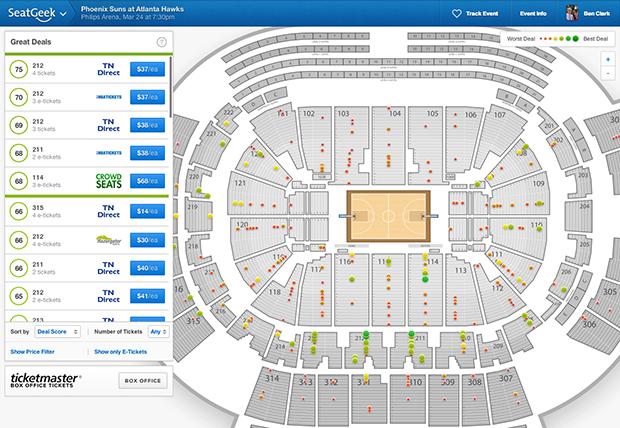
SeatGeek translates this mathematical score into an intuitive, color-coded badge system directly onto their interactive venue maps:
- Dark Green (9-10): An exceptional, rare value. This ticket is priced significantly lower than what historical and structural data indicates it is actually worth.
- Light Green (7-8.9): A solid, high-value deal. You are getting excellent seating placement relative to the current market price.
- Yellow (5-6.9): A fair, market-value price. You aren’t getting a massive bargain, but you aren’t overpaying either.
- Orange/Red (1-4.9): A poor value. These seats are heavily marked up relative to their location, historical trends, or view quality. Avoid these unless you have absolutely no other choice.
The true magic of Deal Score lies in its core objective: It decouples price from value. A $400 ticket can easily have a near-perfect Deal Score of 9.5 if it is located in the front row of a highly competitive venue, while a $45 ticket can score a miserable 2.1 if it is an obstructed seat in the nosebleeds that normally resells for $12.
Decoding the Algorithm: How Deal Score Calculates Value
SeatGeek’s algorithm does not pull these ratings out of thin air. The system processes millions of data points simultaneously to evaluate a single listing. To use it effectively, you need to understand the three primary pillars that drive the math.
1. Granular Seat and Row Logistics
The algorithm knows that not all rows within a specific section are created equal. Row A in Section 101 is exponentially more valuable than Row Z in that exact same section. Deal Score accounts for the specific row depth, the angle relative to the main stage or field, and physical section proximity. It also factors in known venue quirks, such as whether a specific section has an overhanging balcony that blocks the view of the main video board.
2. Deep Historical Pricing Repositories
SeatGeek maintains a massive historical archive of transaction data for every major stadium, arena, and theater across North America. The algorithm knows exactly what a lower-bowl seat for an artist’s previous tour sold for. It compares the current real-time listing price against months of historical data for that specific tour, as well as broader benchmark data for similar artists or sports franchises occupying that exact venue size.
3. Real-Time Macro Demand Shifts
Ticket markets behave exactly like commodities trading. Demand fluctuates based on external variables: local weather forecasts, the day of the week, localized team streaks, or even a sudden shift in an artist’s tour setlist. The Deal Score engine continuously measures the velocity of ticket sales for an event. If tickets are selling incredibly fast, the baseline valuation shifts; if inventory is stagnant and desperate sellers are slashing prices, the algorithm flags those sudden drops instantly with bright green badges.
The “Lowest Price” Trap: Why Cheap Tickets Can Cost You Dearly
When most casual fans log onto a ticket app, their immediate reflex is to click the filter icon and sort the inventory by “Lowest Price”. It feels like the financially responsible thing to do. However, in modern ticket markets, this strategy is a psychological trap that frequently results in a terrible experience.
When you sort strictly by the absolute lowest dollar amount, you are looking at the inventory that nobody else wants. These are the logistical dregs of the stadium:
- Seats stuffed into the highest, steepest corners of the upper deck.
- “Head-on” views that are so far away from the stage that the performers look like ants.
- Obstructed-view listings hidden behind massive sound mixing towers or structural columns.
Worse yet, these “cheap” tickets are often severely marked up by predatory brokers who know that casual buyers search strictly by the lowest price point. A broker might list a terrible upper-deck seat for $60 when its actual true market value is barely $15. If you buy that ticket, you haven’t saved money, you have given a scalper an immense profit margin for a terrible view.
The Power of Sorting by Deal Score
When you shift your behavior and filter an event by Deal Score instead of raw price, the dynamic changes entirely. You force the technology to surface listings where the price-to-quality ratio is skewed heavily in your favor.
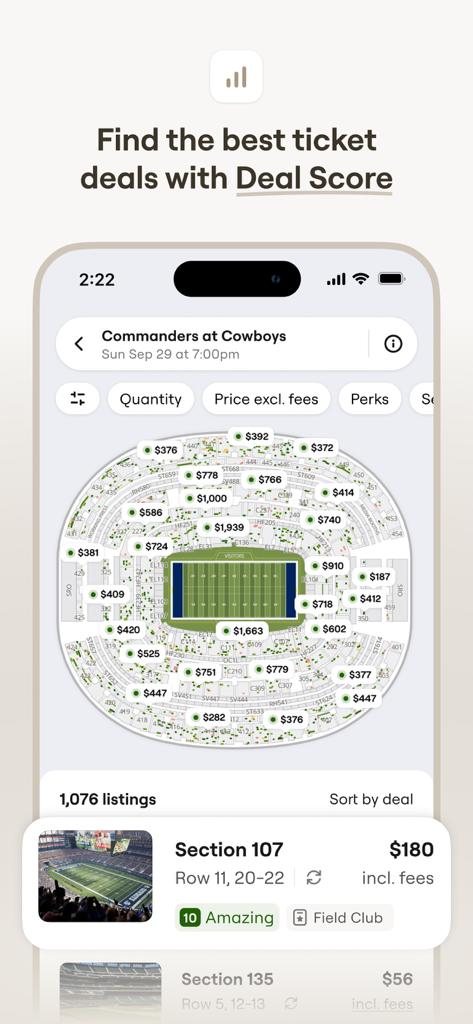
This strategy frequently reveals a phenomenon known as the “Value Upgrade Loop“. Because non-professional resellers often list their personal tickets arbitrarily without looking at market data, mid-tier and lower-bowl seats are frequently underpriced by owners who simply want to recoup their initial costs quickly.
Imagine you are looking for tickets to a massive summer show, and you run into this exact scenario on the app:
- Option A (Filtered by Lowest Price): An upper deck, Row V seat listed for $85. It has a Deal Score of 3.2 (Red) because it is historically overpriced for the back wall of the stadium.
- Option B (Filtered by Deal Score): A club-level, Row B seat located right beside the stage listed for $110. It carries a Deal Score of 9.4 (Dark Green) because the seller priced it low for a quick sale.
If you stick to the “Lowest Price” mindset, you save $25 but sit in a cramped nosebleed section with terrible acoustics. By spending just $25 more on Option B, you get an immense, lower-level club upgrade with premium amenities and an unrestricted view. Deal Score stops you from being penny-wise and pound-foolish.
Pro Strategies: Using Deal Score to Hack Major 2026 Events
As we cross into the peak of the 2026 live entertainment calendar, we are seeing some of the most competitive ticketing environments in human history. Between massive stadium summer tours and the unprecedented frenzy surrounding the international sports landscape in North America, navigating these markets efficiently is non-negotiable.
Here is how to deploy specific Deal Score tactics across different event profiles.
1. High-Density Multi-Day Festivals
For massive, sprawling music weekend events, ticket inventory fluctuates wildly as the event dates approach. Buyers often purchase passes months in advance, only for real-life scheduling conflicts to hit them the week of the show.
- The Tactic: Do not buy early during the initial panic wave. Set up an alert and watch the venue map three to five days before day one. Look specifically for desperate individual sellers dropping multi-day passes at steep losses, which will trigger massive dark-green 9.8 Deal Scores on the platform.
- Action: Keep an eye on secondary markets and track major lineups via the SeatGeek Summer Music Festivals Hub with value filters applied.
2. High-Stakes International Sports Screenings
With global soccer taking over North America this summer, demand for elite international soccer matches is hitting fever pitches. Stadium configurations vary wildly from city to city, meaning an “upper deck” seat in a sleek, modern NFL stadium might actually offer a much better tactical view of the pitch than an expensive lower-row corner seat with poor sightlines.
- The Tactic: Trust the structural data inside the engine. Let the algorithm analyze the venue configurations for you. If a corner lower-bowl seat has a low Deal Score despite looking “close” to the action, the algorithm is warning you that the sightline for a soccer pitch from that low angle is heavily compromised.
- Action: Monitor elite international soccer matchups and prep friendlies via the official SeatGeek International Sports and Soccer Portal to catch high-value ticket drops before matchday.
The Golden Rules of Savvy Ticketing
To ensure you never get taken advantage of by dynamic pricing loops again, memorize this simple three-step checklist every time you open an event map:
- Toggle the “Include Fees” Button Instantly: Never look at a ticket price without fees included. SeatGeek allows you to view the absolute total cost out-of-pocket right from the start. A high Deal Score takes the total cost into account, protecting you from hidden checkout surprises.
- Ignore the Raw Numbers, Watch the Colors: Train your eyes to skip past the text price and look directly for the dark green bubbles. If you see a dark green dot pop up in a section you like, buy it immediately. True 9.5+ deals rarely last on the grid for more than two to three minutes before a professional broker’s scraping bot or an automated buyer snatches them up.
- Monitor the Decay Curve: For massive stadium tours, track the inventory volume across 48 hours. If the overall volume of blue/green dots is rising, sellers are panicking and competing with each other, hold out a little longer. If the green dots are rapidly disappearing and leaving only red behind, the true value window for that event is closing.
Live music and professional sports should be about creating memories, not managing financial dread. By understanding the data layers behind SeatGeek’s Deal Score engine, you can strip the emotion and panic out of the purchasing process. Stop guessing, stop sorting by the lowest price, and let the algorithm protect your wallet.